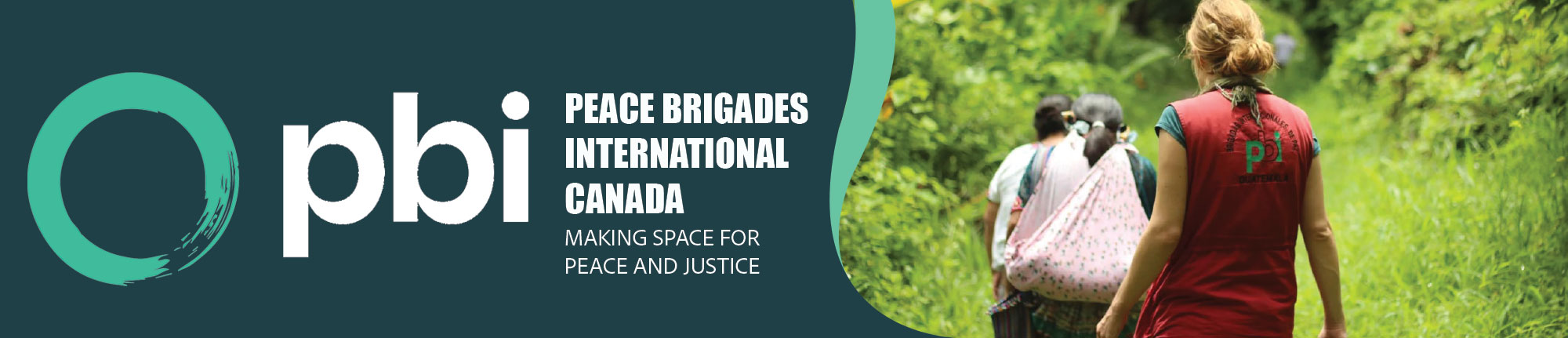
Peace Brigades International

Peace Brigades International (PBI), founded in 1981, is an international non-governmental organization comprised of unpaid volunteers and some paid staff. Inspired by Gandhi, PBI uses nonviolent action to help deter politically motivated violence and expand space for human rights and peace activism in areas of civil conflict. PBI teams don't try to impose solutions from the outside. Instead, they provide moral support and a "breathing space" in which local activists can continue to be protagonists of change. PBI teams can pursue avenues not open to governments or partisan organizations. Free of the strings attached to the U.N. and other governmental bodies, our independent presence earns the trust of local grassroots activists, helping them to endure in the face of severe repression.

PBI does not charge for its services and we do not fund individuals or groups we accompany. While we may provide conflict transformation workshops and nonviolence training, we do not take part in the work of those we accompany.

PBI's major program areas are:
Protective Accompaniment
Peace Education
Conflict Documentation

The fundamental principles upon which we build our work include:
Nonviolence
Non-partisanship
Non-interference in the affairs of groups we accompany
International Character
Consensus decision-making


Protective Accompaniment
PBI has pioneering expertise in accompanying those threatened with political violence. Starting in Guatemala and El Salvador, and since then in Sri Lanka, Colombia, Indonesia and Mexico, our teams have accompanied clergy, union leaders, campesino leaders, human rights activists, and returning exiles (such as Nobel Prize Winner Rigoberta Menchù). We have learned how political violence functions in different contexts and how best to use our international leverage to deter violence. In most instances death squads and other human rights violators do not want their actions exposed to the outside world.

Thus the presence of a PBI volunteer, backed by an emergency response network, deters violence directed against local activists. Where possible PBI initiates contact with all parties to the conflict to inform them of our presence. To increase this effect, PBI forges links with the diplomatic community locally and with media and human rights networks globally.

Armed only with a camera, PBI volunteers are a walking embodiment of the pressure the international human rights community is ready to apply in the event of abuse. As potential perpetrators know, our exposure of such abuse may adversely affect a regime's foreign aid allocation.

PBI's accompaniment can take many forms: escorting an individual 24 hours a day; being present at an office of a threatened organization; accompanying refugees returning to their home communities; serving as international observers at elections and demonstrations. To find out what it's like doing protective accompaniment, read a report on a volunteer's typical day on the Colombia Project and a report from the field from the Nepal Project.


Peace Education
In some countries, notably Haiti, the PBI team has focused on working alongside local conflict resolution trainers to organize workshops about nonviolent methods of resolving conflicts. Methods used include role-plays, theatre pieces and other personal work. To learn more about these approaches, see an update from the Indonesia Project on their Peace Education Team.


Documenting Conflicts and Peace Initiatives
All the PBI teams produce reports on their work and the situation in the countries they work in. They focus on the conflicts and possible solutions that open up which can be supported by the international community. PBI teams help to publicize different forms of nonviolence as they develop in various parts of the world. In this way PBI helps to build and enrich the global nonviolent movement.